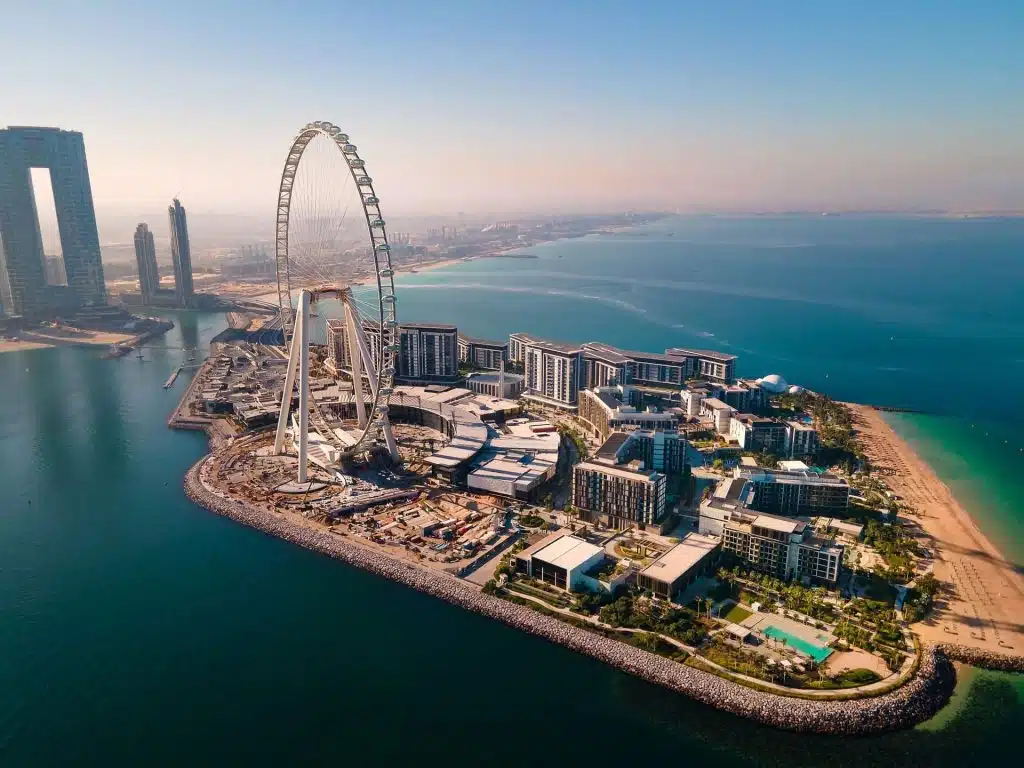
Dubai International Financial Center is rapidly becoming recognized as a premier hub for MEASA. According to the Global Index, published in March 2023, Dubai occupies a leading position among financial centers in the region. Over the past five years, Dubai has consistently maintained its high position worldwide, specifically for capital-holders wishing to enter financial services market-space. Ready-made MSB-license got on local level is lucrative abd efficient option in terms of cost and speed of launching a business-project.
DIFC’s status in the global arena
International experts place DIFC in the top 15 global financial centers, highlighting it among ten key worldwide leaders. DIFC successfully occupies the space-zone of global financial hub between London and New York in the west and Hong Kong and Tokyo in the east. Currently, 4,377 firms are officially launched there; it’s increase of 20% compared to previous statistics.
DIFC-registered business-projects include 17 of the world’s top 20 banking establishments, 5 of the top 10 insurance organizations and 5 of the top 10 asset-managers. Several eminent experts in international law and consulting are based here.
Additionally, DIFC is home to 686 FinTech-companies and innovative enterprises. A total of 1,369 finance and financial innovation business-projects are finding their home in DIFC.
Privileges of getting an MSB-license in DIFC
It stands out as anchor space center in its region, providing a widely-extended spectrum of financial services and maintaining highly-set living standards being respected in worldwide community.
Financial systems there are undergoing key modifications. The rise in digital payments, changes in customer preferences also indicate a shift towards moving away from cash. According to a McKinsey study on consumer behavior in the Middle East, customers prefer digital payment methods, and only 10% are strongly committed to using cash.
Here are some key benefits of establishing an international financially-covering center in such an area, highlighting the whole impact and appeal.
Legislative and regulative bases
- Legislation facilitates global operations.
- Full foreign ownership is permitted.
- No limits for attracting foreign specialists.
- Unconditional possibility of capital withdrawal.
Taxation privileges
- Zero tax-rate on incomes, capital and assets for fifty years from 2004.
- Zero tax on employee income.
Confidence of counterparties
- Efficient and autonomous regulative authority.
- English-language commonly-used law/court system, different from the UAE.
Diverse ecosystem
- Strategic location for regional deals.
- High concentration of international organizations, funds, asset managers, banking and financial facilities.
- Presence of the world’s leading legal and accounting organizations, as well as other highly-qualified services.
Geographical significance
- Management offices, holding companies and family offices are located closer to assets.
- ME, Africa and South Asia are becoming a global hub of economic activity.
- Dubai plays a key role in boosting South-South trade, especially between Asia and Africa.
- There are prospects for effectively using the potential of emerging markets.
Financial companies cover a wide range of business-activities related to payment processing, investment transactions and other monetary transactions. They serve individuals, startups, and large global enterprises alike, providing accounts informational services, payments initiation, and analytics for customer and corporate accounts. Issue of payment instruments, funds transfers, paying systems services, account management and kept value issuance are included in their core.
Regarding category 3D MSB license in Dubai free zone, it is important to note that spreading financial services needs a specific set of permissions classifying a business-structure into the appropriate category. Core business-activities such as payment accounts creation and management, and payment tools providing may qualify your business as “Category 3D.”
What does the permit allow?
- Help clients make international money transfers.
- Offer multi-currency accounts.
- Provide virtual IBAN numbers.
- Issue corporate expense cards for payments to third parties.
- Provide corporate clients with payment accounts and maintain an unlimited balance, as well as carry out fund transfers.
Can DIFC firms serve clients outside the center and in the UAE?
Yes, organizations launched in DIFC and possessing money transfer license United Arab Emirates are able to offer services to their clients not only in center, but also outside it in the UAE. This issue was clearly addressed by Law No. (5) of 2021, which amended the rules regarding provision of services and goods by DIFC-registered organizations .
Under revised law, DIFC-firms are permitted to offer everything outside DIFC-territories if the bulk of those services are offered outside company’s physical offices in the DIFC area. Additionally, marketing and promotional business-activities are also permitted outside the center.
It is important to note next-mentioned: there may be extra rules, particularly in the case of active marketing using DIFC resources. In such situations, a passport mechanism is applied which allows fund managers to register for a fund passport, which can then be offered to the UAE and ADGM. For more detailed advice on this issue, it is recommended to turn to our specialists.
Regarding capital norms for a 3D MSB-permit, basic amount is $200 thousand. However, actual capital standards depend on nature of business-project, volume of operations and projected annual expenses, which are determined using financial models. The three key components of capital include core capital, expense-based capital and transaction-related capital. These figures are calculated on a case by case basis and it is recommended that you contact us for more details on the application procedure and capital calculation.
Application
Application procedure to join DIFC and get money transfer license UAE begins with a thorough understanding of local Financial Authority rules.
Following opening call, a detailed Regulatory Business-Plan (RBP) is prepared with financial projections for rapid review by the DFSA. At this stage you will need:
- identify all financial services and other business-activities entrepreneurs plan to provide;
- highlight all possible commercial and regulative risk factors;
- explain in detail how you will monitor and manage these risks;
- take into account any anticipated future events.
The description of business-structure plays an important role in the application and is an integral part of the decision making. The amount of information provided should be appropriate to nature of future business-project and risks to intended customer audience.
The regulator’s comments are included in the RBP and a comprehensive application is compiled, including policies, processes and other relevant documentation. KYC forms are also prepared for all key persons.
The formal application is then sent to the DFSA, which reviews it within 7-10 working days, after which a detailed review begins, taking 60 to 90 days.
Constant communication with the applicant throughout the process is important and the DFSA conducts in-depth interviews with them. Upon successful completion, approval in principle is issued.
The applicant then proceeds to fulfill the basic conditions, including setting up a legal structure, opening a bank account and contributing share capital. Once these tasks are completed and final documentation is provided, DFSA issues a financial authorization, completing this procedure.
How can we help you
- Preparation of comprehensive application, including mandatory documentation, policies and processes.
- Compilation of detailed KYC (know your customer) materials and preparation of relevant forms for all key persons.
- Submitting a formal application to DFSA and ensuring that the mandatory documentation is submitted on time.
- Cooperation with the regulator throughout the review process, including returning to the initial review two weeks after application sending and subsequent reviews.
- Providing detailed advice and support at all stages of the process, including interviews with authorized persons.
We provide a full-covering range of services for applying for an MSB-license in DIFC, from consultancy to assistance in preparing mandatory documentation. If you’re interested in this area, pay attention to ready-made businesses offered in this category.